
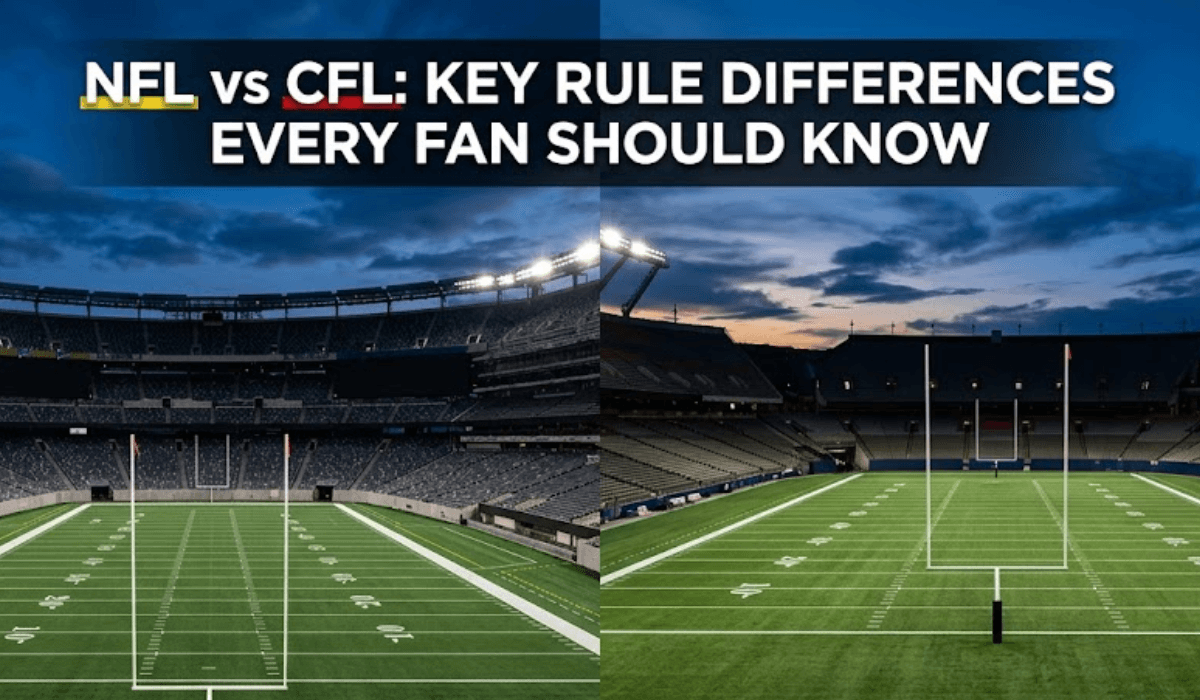
If you’ve ever flipped on a Canadian Football League game expecting “American football, but Canadian,” you’ve probably ended up confused within the first five minutes. The uniforms look familiar. The end zones look familiar. But something feels… off. The field seems bigger. More guys are lining up on offense. And then someone misses a field goal and the other team’s fans cheer like they just won?
You’re not losing your mind. The NFL and CFL share a common ancestry, but over the past century, the two leagues have evolved into genuinely different versions of football — different enough that strategies, player types, and even broadcast pacing change dramatically depending on which league you’re watching.
Whether you’re a lifelong NFL fan curious about the CFL, a Canadian football fan trying to explain the game to American friends, or just someone who stumbled onto a CFL highlight and wants to understand what they’re seeing, this guide breaks down every major rule difference between the two leagues — and explains why each one matters.
1. Field Size: The CFL Is Simply Bigger
The most obvious difference between the two leagues is the size of the playing field, and it’s not a small gap.
The CFL field measures 110 yards long and 65 yards wide, with end zones that stretch 20 yards deep. Add it all up, and a CFL field — including both end zones — comes out to 150 yards long. The NFL field, by comparison, is 100 yards long and 53⅓ yards wide, with end zones just 10 yards deep, for a total length of 120 yards.
That’s an extra 30 yards of length and roughly 12 extra yards of width compared to the NFL. To put that in perspective, the CFL field is about 22% wider and 25% longer overall.
Why does this matter? More width means more room for receivers to operate on the outside, more space for return specialists to find running lanes, and more real estate for defenses to cover. The deeper end zones also change red-zone strategy — routes that would be cramped against the back line in the NFL have room to breathe in the CFL, which is part of why CFL offenses tend to be so pass-heavy near the goal line.
There’s also a quirky midfield difference: the NFL’s midfield stripe is the 50-yard line, while the CFL’s is the 55-yard line, simply because the field is longer.
2. Three Downs vs. Four Downs
This might be the single biggest strategic difference between the two leagues, and it’s the one that changes everything else about how the game is played.
In the NFL, an offense gets four downs to gain 10 yards. In the CFL, offenses get only three.
That one missing down completely reshapes offensive philosophy. NFL teams can afford to play it relatively safe on first and second down, knowing they have a “cushion” down to work with if a play doesn’t go as planned. CFL offenses don’t have that luxury. With only three chances to move the ball 10 yards, CFL teams tend to be far more aggressive — throwing the ball more often, taking more downfield shots, and rarely “wasting” a down on a conservative running play just to set up the next one.
This is also why CFL games often look faster and more pass-driven than NFL games. When you only have three cracks at a first down, every play has to count.
3. 12 Players on the Field Instead of 11
In the NFL, each team has 11 players on the field per play — the standard most football fans are used to. In the CFL, each team fields 12 players.
That extra player is almost always used on offense, typically as an additional slot receiver or a hybrid running back/receiver type. Combined with the larger field, this extra body opens up more route combinations and forces defenses to defend a wider variety of formations.
On defense, the CFL also structures its secondary differently. Rather than the two safeties common in NFL defensive schemes, CFL defenses typically deploy two defensive halfbacks and a single safety — a setup built around defending that extra width and that extra eligible receiver.
4. Pre-Snap Motion: “The Waggle.”
Watch a CFL offense line up before the snap, and you’ll often see multiple receivers and backs jogging toward the line of scrimmage before the ball is snapped — a tactic commonly called “the waggle.” Multiple offensive players are allowed to be in motion simultaneously, including moving toward the line.
The NFL is far more restrictive. Only one offensive player is allowed to be in motion at the snap, and that player can only move laterally or backward — never toward the line of scrimmage.
The practical effect? CFL receivers can build up speed before the ball is even snapped, giving them a literal head start on their routes. This contributes heavily to the CFL’s reputation as a faster, more wide-open passing league, while the NFL’s more restrictive motion rules tend to produce more static, set formations before each snap.
5. The Play Clock: 20 Seconds vs. 40 (or More)
Pace of play is another area where the two leagues diverge sharply. The CFL operates on a 20-second play clock once the ball is spotted and ready for play. The NFL gives offenses significantly more time between snaps — its play clock runs up to 40 seconds from the end of the previous play (or up to 25 seconds following certain stoppages).
The shorter CFL clock means fewer prolonged huddles, less time for elaborate pre-snap adjustments, and generally more plays packed into the same amount of game time. If NFL games can sometimes feel like they crawl between snaps, CFL games tend to move at a noticeably brisker pace.
6. Goalpost Placement
Here’s a difference that seems small but actually affects strategy in a big way: where the goalposts sit.
In the NFL, the goalposts are mounted at the very back of the end zone, 10 yards behind the goal line. In the CFL, the goalposts sit directly on the goal line itself — right at the front of that much deeper, 20-yard end zone.
This placement difference is part of why CFL field goal distances often end up comparable to NFL field goal distances, even with a longer field overall — the CFL kicker doesn’t have to clear that extra 10 yards of end zone to reach the posts.
See also: How to Host the Perfect NFL Game Day Watch Party (Tailgate Guide)
7. The Rouge: The CFL’s Most Confusing Rule (To Americans)
If there’s one rule that consistently breaks the brains of NFL fans watching the CFL for the first time, it’s the rouge — also known as a single point.
Here’s how it works: if a kicked ball (whether on a field goal attempt, a punt, or a kickoff) goes into or through the end zone and the receiving team fails to either run it out of the end zone or have it go out of bounds, the kicking team is awarded one point. The receiving team then takes possession at their own 35-yard line (recently standardized; historically the 25, but rules have shifted the spot in different eras — always confirm with the current CFL rulebook for the exact yard line in a given season).
This single point might sound minor, but it has decided real games — including ties broken in the dying seconds by a missed field goal that sails through the end zone untouched. For NFL fans used to a missed kick simply meaning “no points, change of possession,” watching a missed CFL field goal score a point can be genuinely jarring the first time you see it.
8. Overtime Format
NFL overtime starts with a coin toss, and (depending on the situation — regular season vs. playoffs) can involve a single overtime period with both teams guaranteed possession under modern rules, followed by sudden death if the score remains tied.
The CFL takes a different approach in its overtime, generally giving each team one possession starting from a set yard line, with both teams attempting two-point conversions rather than extra-point kicks if the game remains tied after the first round — creating a much higher-stakes, “win or go home immediately” feel compared to the NFL’s format.
Because overtime rules in both leagues are reviewed and occasionally tweaked between seasons, it’s always worth double-checking the current league rulebook before the playoffs if you want the exact procedure for a given year.
Why These Differences Matter for Fans
None of this makes one league “better” than the other — it just makes them different games built around different philosophies. The NFL’s extra down, restrictive motion, and longer play clock create a more methodical, chess-match style of football. The CFL’s bigger field, extra player, aggressive motion rules, and shorter clock create a faster, riskier, more pass-heavy product.
If you’re a fan trying to follow both leagues, the biggest mental adjustment is usually the down count — once you internalize that CFL offenses are playing with one less “out” on every series, the rest of the differences (the aggressive passing, the motion, the pace) start to make a lot more sense.
Frequently Asked Questions
1. Why does the CFL only have three downs while the NFL has four?
The CFL’s three-down system traces back to the early days of North American football, when both leagues’ predecessors initially used three downs. The NFL later moved to four downs, while the CFL retained the original three-down structure, which continues to shape its faster, pass-oriented offensive style today.
2. Is the CFL field really bigger than the NFL field?
Yes. The CFL field is 110 yards long and 65 yards wide with 20-yard end zones, while the NFL field is 100 yards long and 53⅓ yards wide with 10-yard end zones. Including end zones, the CFL field totals 150 yards versus the NFL’s 120 yards.
3. What is a “rouge” in CFL football?
A rouge, or single point, is awarded to the kicking team when a kicked ball (field goal, punt, or kickoff) enters the end zone and the receiving team fails to return it out. It’s one of the most unique scoring rules in football and has no direct NFL equivalent.
4. Why does the CFL have 12 players on the field instead of 11?
The CFL’s larger field requires more players to adequately cover the additional space. The extra player is typically used as another offensive receiver, which is part of why CFL offenses tend to spread the field and pass more frequently than NFL offenses.
5. Which league has faster-paced games, the NFL or the CFL?
The CFL is generally considered faster-paced due to its 20-second play clock (compared to the NFL’s longer clock), its three-down system that forces quicker offensive decisions, and its more permissive pre-snap motion rules that allow multiple players to be moving before the snap.
Rule details reflect standard NFL and CFL regulations as commonly published; both leagues periodically adjust specific rules (especially overtime procedures and exact rouge return-yard-line placement) between seasons, so always verify against the current official rulebook for the season in question.
The AmericanFootballSchedule.com Editorial Team is a group of football writers, schedule analysts, and die-hard NFL fans dedicated to providing the most accurate and complete American football schedule information on the web. Our team covers all 32 NFL teams, every FBS college football program, and the full CFL season from opening kickoff through the Grey Cup.