
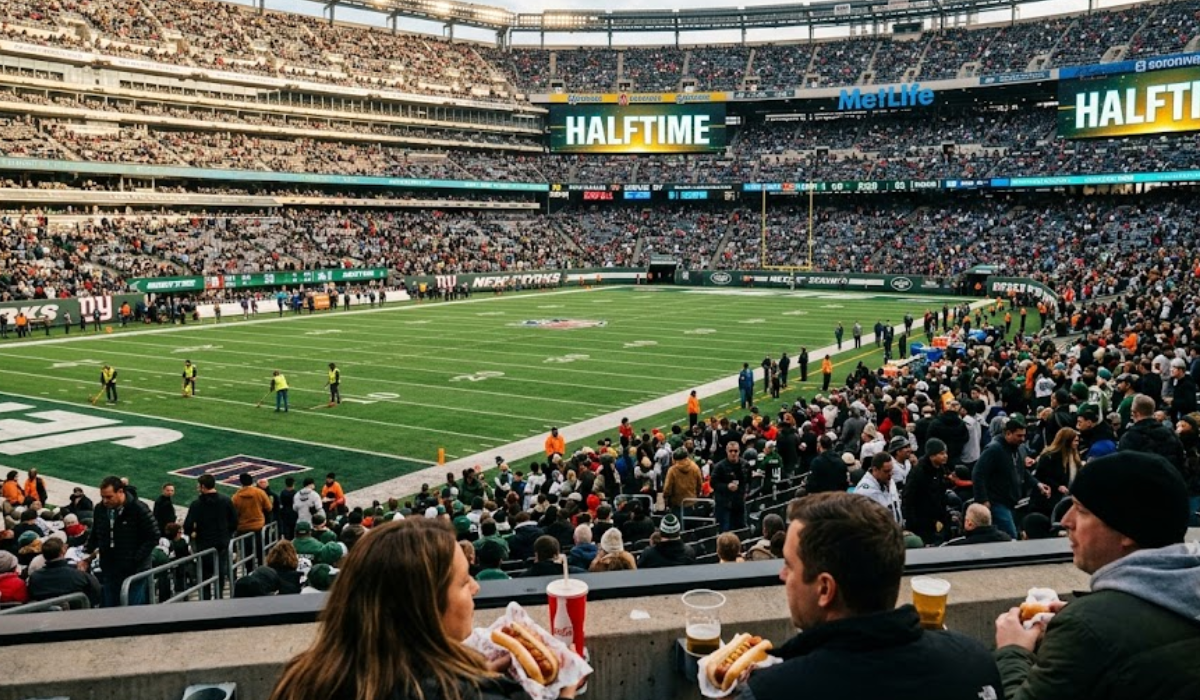
NFL halftime is officially 13 minutes long, as listed in the 2025-26 NFL rulebook under Rule 4, Section 1, Article 3. In practice, between officials resetting the field, both teams coming out of the locker room, and broadcast coverage, halftime typically runs closer to 15 minutes from when the teams walk off to when the second-half kickoff happens.
The Super Bowl is a completely different story — Super Bowl halftime runs 25 to 30 minutes to accommodate the halftime show, stage setup, and teardown.
Here is the full breakdown across every type of game.
Regular Season Halftime: 13 Minutes by Rule, 15 in Practice
The NFL rules book sets halftime at 13 minutes. That is the mandatory break between the second and third quarters in every regular season game.
What actually happens during those 13 minutes:
- Players head to the locker room for a few minutes of rest, hydration, and medical attention
- Coaches meet with coordinators and go over adjustments for the second half
- Trainers address injuries and tape up anything that needs attention
- Broadcasters run commercials, halftime analysis, and highlights from other games
- Field crews clean up the turf, replace yard markers, and prepare for the second-half kickoff
The 13-minute clock starts when the halftime whistle blows. Teams need to be back on the field and lined up for the second-half kickoff by the time it expires. Late returns from the locker room can result in a penalty.
Why 15 minutes in reality: Even though the rulebook says 13 minutes, the real-world gap between the final play of the second quarter and the second-half kickoff is typically closer to 15 minutes. Players do not immediately sprint to the locker room the instant the half ends, and the broadcast transitions take a moment. Most fans watching at home experience halftime as roughly 15 to 20 minutes of broadcast time.
Playoff Halftime: Same 13 Minutes
The halftime length does not change for playoff games. Wild Card, Divisional Round, Conference Championship — all use the standard 13-minute halftime defined in the rulebook.
The only NFL postseason game with a different halftime is the Super Bowl.
Super Bowl Halftime: 25 to 30 Minutes
The Super Bowl halftime show is one of the most-watched entertainment events in the world, and it requires significantly more time than a standard game break.
Why it’s so much longer:
The halftime performers and production crew need time to set up elaborate staging, sound systems, lighting rigs, and special effects while players are in the locker room. After the show, all of that equipment needs to be removed from the field quickly enough that the second half can begin.
The typical Super Bowl halftime timeline:
- Teams exit the field: ~5 minutes
- Stage setup and pre-show preparation: during teams’ locker room time
- Halftime show performance: typically 12 to 15 minutes of actual music
- Stage breakdown and field restoration: ~10 minutes
- Teams warm up and return to field
- Second-half kickoff
Total elapsed time: 25 to 30 minutes from the end of the second quarter to the second-half kickoff.
Super Bowl LX (February 2026): The halftime show at Levi’s Stadium in Santa Clara ran approximately 28 minutes from first to last play of the second half, consistent with recent Super Bowl halftime lengths.
How Long Is an NFL Game Total?
Since halftime is part of the game, it helps to put it in context of the full runtime.
Official regulation time: 60 minutes (four quarters of 15 minutes each)
Average real-world runtime: 3 hours and 12 minutes from kickoff to final whistle
That means a 60-minute game on the clock becomes a 3-hour-plus event in real life. Here is where the time goes:
| Element | Approximate Time |
|---|---|
| Actual playing time | ~11 minutes |
| Commercial breaks | ~50 minutes |
| Halftime | 13–15 minutes |
| Between-play time (huddles, substitutions, clock running) | ~75 minutes |
| Replay reviews, timeouts, penalties, injuries | ~30 minutes |
Yes — the ball is actually in motion for roughly 11 minutes of a 3-hour NFL game. The rest is strategy, preparation, and television. This is very different from soccer, basketball, or hockey, where continuous action makes up a much larger share of the broadcast.
Super Bowl total runtime: Between 3 hours 45 minutes and 4 hours, due to the extended halftime show and additional commercial time.
See also: 2026-2027 NFL Schedule
How NFL Halftime Compares to Other Sports and Levels
| Game Type | Halftime Length |
|---|---|
| NFL Regular Season | 13 minutes (rule) / ~15 minutes (real) |
| NFL Playoffs (non-Super Bowl) | 13 minutes |
| Super Bowl | 25–30 minutes |
| College Football (NCAA) | 20 minutes |
| High School Football | 20 minutes |
| CFL | 15 minutes |
College football halftime is noticeably longer at 20 minutes — which is one reason the average college football game (3 hours 24 minutes) runs longer than the average NFL game (3 hours 12 minutes), despite both having the same 60-minute regulation.
What Players and Coaches Do During Halftime
Thirteen minutes sounds short, but NFL teams make every second count. Here is what typically happens:
The first three to four minutes: Players come off the field and get to the locker room. Trainers address injuries immediately. Hydration and energy replenishment happen fast — players have burned enormous calories in the first half.
Minutes four through ten: Coaches deliver adjustments. The offensive coordinator might show a specific coverage the opposing defense has been running. The defensive coordinator shows tendencies they want to stop in the second half. Quarterbacks go over the play sheet.
Final two to three minutes: Players stretch, receivers run routes mentally, linemen review blocking assignments. Position coaches give final reminders. The head coach says something to the full team.
Then everyone runs back onto the field.
It moves fast. Most players say the halftime break feels much shorter than 13 minutes. By the time the medical staff has looked at a tweaked hamstring and a coach has run through adjustments, it is time to go.
Can Halftime Be Extended?
Yes, in specific circumstances. If there is severe weather, a technical issue with the stadium, or a medical emergency on the field that requires attention before the game can continue, officials can extend the halftime break. This is rare in the regular season.
At the Super Bowl, the halftime length is essentially at the discretion of the broadcast and production team, with a window agreed upon in advance with the league. If a halftime show runs long, the NFL has occasionally started the second half slightly late without penalty — though they try to avoid it.
See also: How Much Do NFL Refs Make in 2026? Salary, Bonuses, and the Full Breakdown
Why the NFL Keeps Halftime Short
The NFL’s 13-minute halftime is deliberately short compared to other sports and levels of football. The reasons are practical:
Broadcast scheduling: An NFL game occupies a specific television window. Adding 5 minutes to halftime pushes the game into the next broadcast slot, which disrupts network scheduling for the rest of the day.
Player performance: Research has shown that extended breaks cause players’ body temperatures and muscle activation to drop, increasing injury risk when they return to full-speed play. A shorter break means players stay closer to game-ready condition.
Momentum and pacing: The NFL and broadcast partners have invested heavily in keeping games moving. Longer halftime means more viewers switching channels or losing interest during the break.
The AmericanFootballSchedule.com Editorial Team is a group of football writers, schedule analysts, and die-hard NFL fans dedicated to providing the most accurate and complete American football schedule information on the web. Our team covers all 32 NFL teams, every FBS college football program, and the full CFL season from opening kickoff through the Grey Cup.